
You Don't Have a Productivity Problem
A few weeks ago I sat in on a webinar about productivity and prioritization, and one line has stuck with me ever since: "You have a volume problem masquerading as a productivity problem."
That one hit home. Most of us assume that if we just got faster, more organized, or found the right app, we could finally get everything done. But productivity was never about getting everything done. It's about identifying the few things that actually move your life and work forward, and giving them your best time and energy.
The goal isn't to get better at managing an overwhelming workload. It's to spend more of your time on the work that matters most.
Climbing the Productivity Ladder
The webinar described productivity as a ladder with four levels. The higher you climb, the more intentional you become and the more control you have over your time.
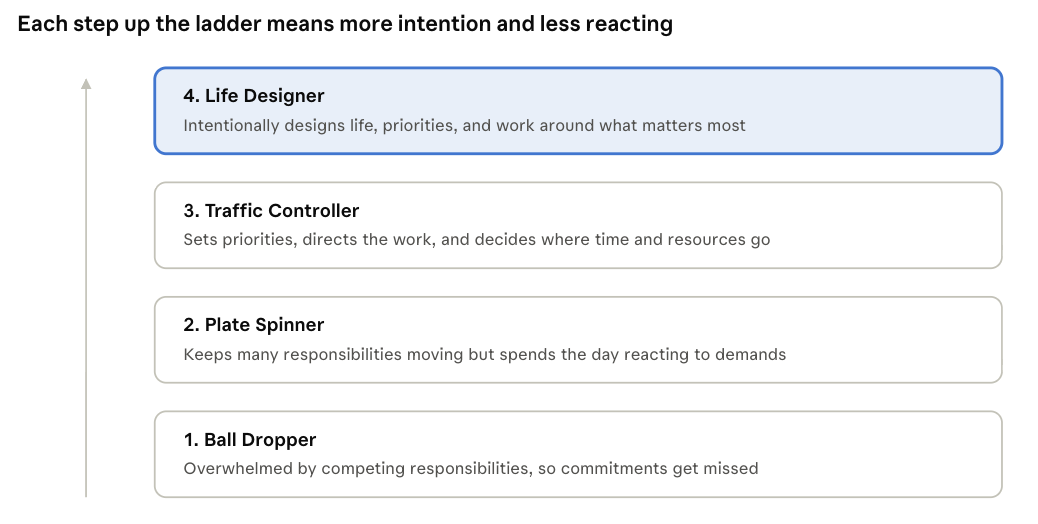
At the bottom is the Ball Dropper. This is the person overwhelmed by competing responsibilities, where commitments get missed and work goes unfinished. One step up is the Plate Spinner, who keeps a lot of things moving but spends most of the day reacting to whatever demands attention next.
The third level is the Traffic Controller. Instead of just reacting, this person sets priorities, directs the work, and decides where time and resources should go. At the top is the Life Designer, someone who intentionally builds their life, priorities, and work around what matters most.
I think most leaders live somewhere between plate spinning and traffic control. The invitation is to keep climbing, moving from constantly reacting to our responsibilities toward intentionally designing how we spend our time.
A Simple Filter for What Deserves Your Time
One of the most practical tools from the webinar was a three-question filter. You can run it on any task, meeting, request, or opportunity that lands on your plate.
The first question is about you: is this work in my wiring? Does it line up with your strengths, skills, and passions? Work that sits where passion and proficiency meet tends to leave you energized instead of drained.
The second question is about return: does this work produce meaningful results? Not every activity gives back the same. Some things are simply not worth the time, energy, and attention they require.
The third question is about timing: does this matter right now? Something can be valuable and still not be the right priority for this season. Timing matters just as much as importance.
Your strongest priorities are the ones that pass all three. When something fits your wiring, produces real results, and matters right now, that's where your best energy belongs.
Important Isn't Always Urgent
This was the part that challenged me most. Some of our most important responsibilities rarely demand our attention right away.
Emails, requests, and daily tasks are loud. They create urgency and pull us toward them. Meanwhile, the meaningful long-term work stays quiet, so it keeps getting pushed to next week. Developing future leaders, strategic planning, building systems that last, investing in relationships, and making time for personal growth and reflection all fall into that quiet category.
If we only respond to what's urgent, we will keep neglecting what's important. And over time, the important things are usually the ones that shape our future.
What This Looks Like for Leaders
As an executive pastor, I've been thinking about how to put this into practice with our team. A few simple shifts stand out.
Start each week by naming the three outcomes that would make the biggest impact. Before handing something off, ask whether it fits the strengths and role of the person receiving it. Take an honest look at your meetings and whether each one actually produces value. Then protect time on your calendar for the important work that never feels urgent, like coaching your team and moving big projects forward without interruptions.
For me, the biggest reminder is that a productive day isn't measured by how much I personally get done. It's easy to count the problems solved, emails answered, or meetings finished. But some of the most valuable work is investing in the people and systems that help our whole team thrive, and that keep those same problems from coming back.
Making Room for the Right Things
If I had to sum up the whole webinar, it would be this. Being busy doesn't necessarily mean being productive. Not everything important is important right now. And the goal isn't to manage more responsibilities. It's to make room for the right ones.
So this week, before you add one more thing to your list, run it through the filter. Ask if it fits you, if it's worth it, and if it matters now. You might find that the path to getting more done starts with doing less.
Questions to Ask Yourself
What's one thing on my plate right now that doesn't fit my wiring, produce real results, or matter in this season?
What important but not urgent work have I been putting off, and when will I make time for it this week?